Pareto Optimality Without Communication: A Close Read of Marden, Young & Pao (2014)
In multi-agent reinforcement learning (MARL), the holy grail is often coordination without coordination , agents that achieve system-wide efficiency despite having no model of the environment, no knowledge of others' actions or utilities, and zero communication. Most payoff-based or regret-minimizing algorithms settle for Nash equilibria, which can be arbitrarily inefficient.
A landmark 2014 paper by Jason R. Marden, H. Peyton Young, and Lucy Y. Pao (“Achieving Pareto Optimality Through Distributed Learning”) shows this is not inevitable. They introduce a completely uncoupled, payoff-based learning rule that, in any finite $n$-person game with generic payoffs (and a mild interdependence condition), makes the welfare-maximizing action profile stochastically stable. Agents only ever observe their own past actions and realized payoffs , yet the system reliably locks onto the Pareto optimal outcome.
Here are the six most surprising, counter-intuitive, and impactful takeaways , with the math, the intuition, and the MARL implications.
1. Completely payoff-based (uncoupled) learning can reach global efficiency in arbitrary games
Traditional distributed optimization or MARL often requires convexity, potential-game structure, or communication graphs. This algorithm needs none of that. Each agent $i$ maintains only a benchmark action $\bar a_i \in A_i$, a benchmark payoff $\bar u_i \in \mathrm{range}(U_i)$, and a binary mood $m_i \in \{C, D\}$ (“content” or “discontent”). The update rule is purely a function of the agent's own history:
$$p_i(t) \;=\; F_i\Big( \big\{\, (a_i(\tau),\, U_i(a(\tau))) \,\big\}_{\tau = 0 \ldots t-1} \Big)$$
No other agents' actions or utilities are ever observed. Yet the joint process converges (in the sense of stochastic stability) to the action profile $a^\ast$ that maximizes $W(a) = \sum_i U_i(a)$.
Why this matters for MARL. This is model-free, communication-free MARL that solves general-sum coordination problems where potential-game or consensus-based methods fail , e.g. wind-farm control with unknown aerodynamic wake interactions.
2. The mood dynamics are minimalist , yet mathematically perfect for exploration/exploitation
Fix small $\varepsilon > 0$ (exploration rate) and $c \ge n$. Agent dynamics:
Content ($m_i = C$):
$$p_i^{\bar a_i} = 1 - \varepsilon^{c}, \qquad p_i^{a_i} = \frac{\varepsilon^{c}}{|A_i| - 1} \;\text{ for } a_i \ne \bar a_i.$$
Discontent ($m_i = D$):
$$p_i^{a_i} = \frac{1}{|A_i|} \;\text{ for all } a_i.$$
After playing $a_i$ and receiving $u_i = U_i(a_i, a_{-i})$, the state update is deterministic on the match and probabilistic on the mismatch:
- If content and $(a_i, u_i)$ exactly matches the benchmark → stay content.
- Otherwise → set new benchmark to $(a_i, u_i)$ and become content with probability $\varepsilon^{\,1 - u_i}$, discontent with probability $1 - \varepsilon^{\,1 - u_i}$.
The exponent $1 - u_i$ makes high-payoff outcomes “stickier” , lower resistance to acceptance. A single scalar $\varepsilon$ controls the entire exploration/exploitation tradeoff across the population.
Reflection. Two moods and one benchmark pair replace the four-mood machinery (content / discontent / hopeful / watchful) of earlier regret-testing algorithms. Simpler, yet stronger guarantees.
3. Stochastic stability via resistance trees selects exactly the welfare-maximizing states
The joint state space is $Z = \prod_i \big(A_i \times U_i \times \{C, D\}\big)$. The dynamics form a regular perturbed Markov chain $P^{\varepsilon}$. When $\varepsilon = 0$, the unperturbed process $P^{0}$ has recurrence classes: the singletons $C^{0}$ (all agents content and benchmarks aligned with the current action profile) plus one big class $D^{0}$ (all discontent).
Using Young's resistance-tree method, the stochastic potential of any $z = [\bar a, \bar u] \in C^{0}$ is
$$\gamma(z) \;=\; c\,(|C^{0}| - 1) + \sum_i (1 - \bar u_i) \;=\; c\,(|C^{0}| - 1) + n - W(\bar a).$$
The efficient profiles minimize this potential (equivalently, maximize $W(\bar a)$). All other states have strictly higher potential. Hence, as $\varepsilon \to 0$, the stationary distribution $\mu^{\varepsilon}$ concentrates on the unique (or all tied) welfare-maximizing content states.
Key resistance facts:
- $r(z \to D) = c$ (one agent must experiment)
- $r(D \to z) = n - W(\bar a)$ (each agent must “accept” its benchmark payoff)
- $r(z \to z') \in [c, 2c)$ for $z \ne z' \in C^{0}$
The math is clean, elegant, and directly imported from large-deviations theory , a bridge between evolutionary game theory and distributed control.
4. It achieves Pareto optimality even when that outcome is not a Nash equilibrium
Classic result: in the scaled Prisoner's Dilemma
| A | B | |
|---|---|---|
| A | 3/4, 3/4 | 0, 4/5 |
| B | 4/5, 0 | 1/3, 1/3 |
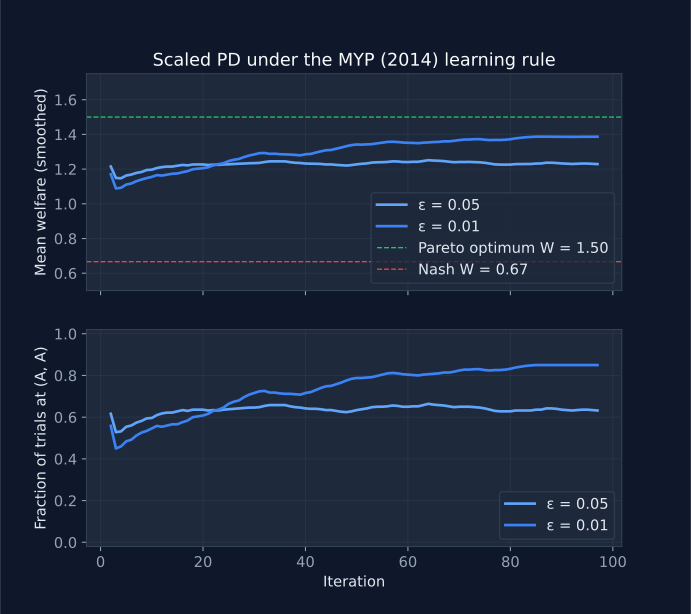
$(B,B)$ is the unique pure Nash equilibrium, yet $(A,A)$ is the unique stochastically stable state under this dynamics. The resistance-tree calculation shows $\gamma(AA)$ is strictly smaller than $\gamma(BB)$ by $4/3$. Simulations (§6) confirm that even at moderate $\varepsilon$ the majority of trials settle at $(A,A)$ within a few hundred iterations , well before the asymptotic regime where the stochastic-stability argument formally applies.
Counter-intuitive punchline. The algorithm prefers cooperation over defection because high-welfare outcomes are easier for agents to “accept” into their benchmark (lower resistance $1 - u_i$).
5. Interdependence is necessary , and there is a fundamental impossibility result
Definition (Interdependence). No proper subset of agents can be isolated; every coalition interacts with its complement.
Without it, inefficient profiles can become stochastically stable (the paper gives an explicit 2-player counter-example). Moreover, Proposition 4 proves there exists no uncoupled learning algorithm that guarantees efficiency in all finite games. The interdependence condition is tight.
MARL lesson. Any claim of “universal” decentralized optimality must confront this combinatorial barrier.
6. Practical performance beats the $\varepsilon \to 0$ theoretical limit
Simulations on the scaled PD make the finite-horizon picture concrete (Figure 2). Within $100$ iterations a majority of trials have already committed to $(A,A)$: about $85\%$ for $\varepsilon = 0.05$ and $60\%$ for $\varepsilon = 0.01$. Mean welfare trails the fraction-at-Pareto because trials that land in a suboptimal basin stay there for many steps before a random mood flip frees them. At this horizon, larger $\varepsilon$ is actually faster , the acceptance probability $\varepsilon^{1 - u}$ at the Pareto payoff is $\approx 0.47$ for $\varepsilon = 0.05$ but only $\approx 0.32$ for $\varepsilon = 0.01$, so a bigger $\varepsilon$ commits to $(A,A)$ on fewer attempts. Smaller $\varepsilon$ wins asymptotically (its experimentation rate $\varepsilon^{c}$ is lower, so once content it stays put), but reaching that regime requires many more iterations than shown here.
Cons and open questions:
- Hitting times grow rapidly as $\varepsilon$ shrinks.
- The dynamics exhibit commitment: the system “locks” onto one profile and only rarely escapes , useful for stability, costly for adaptability in non-stationary environments.
- Compared with Pradelski & Young [2] (which adds transitional moods to target Pareto-Nash equilibria), this rule sacrifices Nash guarantees for pure welfare maximization , a deliberate design choice with real engineering payoff.
From math to code: reproducing the scaled PD
The update rule is small enough to fit on a napkin. Below is a self-contained Python implementation for the 2-player scaled PD above. The full script (including the plotting code that produced Figure 2) is available as scaled_pd.py.
import random
from dataclasses import dataclass, field

@dataclass
class Agent:
    """Completely uncoupled payoff-based learner (Marden-Young-Pao 2014)."""
    n_actions: int
    epsilon: float
    c: int                           # c >= n
    benchmark_action: int = 0
    benchmark_payoff: float = 0.0
    mood: str = "C"                  # "C" (content) or "D" (discontent)
    rng: random.Random = field(default_factory=random.Random)

    def choose_action(self) -> int:
        if self.mood == "D":
            return self.rng.randrange(self.n_actions)
        # Content: play benchmark with prob 1 - eps^c, else uniform over others.
        if self.rng.random() < 1.0 - self.epsilon ** self.c:
            return self.benchmark_action
        others = [a for a in range(self.n_actions) if a != self.benchmark_action]
        return self.rng.choice(others)

    def update(self, action: int, payoff: float) -> None:
        matches = (action == self.benchmark_action
                   and abs(payoff - self.benchmark_payoff) < 1e-12)
        if self.mood == "C" and matches:
            return                   # stay content, benchmark unchanged
        # Mismatch: adopt new benchmark and (probabilistically) become content.
        self.benchmark_action = action
        self.benchmark_payoff = payoff
        accept_prob = self.epsilon ** (1.0 - payoff)
        self.mood = "C" if self.rng.random() < accept_prob else "D"
That is the entire learning rule. No gradients, no communication, no model of the opponent. To reproduce the scaled PD, pair two of these agents, draw joint payoffs from the matrix in §4, and iterate. The full runner that produced Figure 2 below is in scaled_pd.py.
Final thought
Marden, Young & Pao's algorithm is one of those rare results that feels almost too good to be true: a handful of local rules, zero communication, and global optimality emerges from stochastic stability. For MARL researchers building systems that must operate under extreme information constraints , wind farms, ad-hoc networks, large-scale robotics , it remains a foundational blueprint.
The lingering question: can we marry this mood-based stochastic stability with modern deep-RL function approximation and partial observability while preserving the same asymptotic welfare guarantees? The theory is there. The next breakthrough is waiting in the code.
References
- Marden, J. R., Young, H. P., & Pao, L. Y. (2014). Achieving Pareto Optimality Through Distributed Learning. SIAM Journal on Control and Optimization, 52(5), 2753–2770. doi:10.1137/110850694
- Pradelski, B. S. R., & Young, H. P. (2012). Learning efficient Nash equilibria in distributed systems. Games and Economic Behavior, 75(2), 882–897.
- Young, H. P. (1993). The evolution of conventions. Econometrica, 61(1), 57–84. (Origin of the resistance-tree method used throughout.)
- Foster, D. P., & Young, H. P. (2006). Regret testing: learning to play Nash equilibrium without knowing you have an opponent. Theoretical Economics, 1(3), 341–367.
- Marden, J. R., Arslan, G., & Shamma, J. S. (2009). Cooperative control and potential games. IEEE Transactions on Systems, Man, and Cybernetics, Part B, 39(6), 1393–1407.